On this page
We may earn a commission if you buy through links here. Brands do not pay to be listed. As an Amazon Associate I earn from qualifying purchases.
Test your water before you shop
The right purifier depends on your water, not on the number of stages printed on the box. So check these things first.
- Know your source. Is it a municipal line, a borewell, a tanker, or a mix of these? Tanker and borewell water can change through the year.
- Check TDS. TDS means total dissolved solids. A pocket TDS meter is cheap and easy to use. Test the water in a clean steel glass, on more than one day.
- Test borewell water properly. A TDS meter cannot show germs, arsenic or fluoride. A water-testing lab can. Ask your local water department where to go.
Hard water, common in many Indian cities, leaves white marks on taps and kettles. It can also shorten the life of filters.
RO, UV and UF in plain words
| Type | What it does | Limits | Needs power? |
|---|---|---|---|
| RO (reverse osmosis) | Pushes water through a very fine membrane, removes most dissolved salts | Wastes some water, costs more to run | Yes |
| UV (ultraviolet) | Light treats germs in the water | Does not remove dissolved salts or dirt | Yes |
| UF (ultrafiltration) | Fine filter that holds back particles | Does not remove dissolved salts | Some models do not need it |
| TDS control | Lets a small amount of water skip the RO stage to adjust TDS and taste | Depends on setting it up for your water | Comes with RO |
Many purifiers combine these. A long name is not a reason to buy. Ask what each stage does for your water. If a name has letters you do not know, ask the seller to explain them.
Which type suits your water?
These are rough starting points, not safety advice. A lab report on your own water overrides them.
| Your water | Start by looking at |
|---|---|
| Municipal, low TDS, tastes fine | UV and UF, no RO |
| Municipal, TDS up to 500 mg/L, taste is a problem | RO with TDS control, or stay with UV and UF |
| TDS above 500 mg/L | RO |
| Borewell or tanker | Lab test first, then usually RO |
| Low water pressure | A model with a booster pump, or a pump added |
The Indian drinking water standard, IS 10500, gives 500 mg/L as the acceptable TDS limit. It allows up to 2000 mg/L when there is no other source.
When RO is not needed
If your TDS is low and your water tests fine, RO adds wasted water and service bills without a clear gain. Some salespeople run a water demo with a device that makes the water turn dark. This proves nothing about your water.
Marketing words such as alkaline, copper and mineral do not tell you much. Ask what the stage changes, and how you can check that yourself.
Top 5 water purifiers to look at
We have not tested these. The details come from each Amazon listing, and the pros and cons are our reading of those details and of this type of product. This is a shortlist, not a ranking. We picked popular listings on Amazon.in, so the order does not mean one is better. All of them include RO, so they suit the higher TDS and borewell rows above. Check the current price, warranty and reviews on Amazon.
| Product | Type | Listed detail |
|---|---|---|
| Aquaguard Delight Aquasaver | RO+UV+UF | 2-year filter life listed |
| Aquaguard Delight Aquasaver | RO+UV+UF+MC | Stainless steel tank |
| KENT Grand | RO+UF+TDS Control | UV LED tank |
| KENT Supreme Plus | RO+UV+UF+TDS Control | See listing |
| Urban Company Native M1 | RO+UV | 10-stage, no service for 2 years listed |
Where a listing gives a filter life or a no-service period, read the terms. Ask which parts it covers, and if it depends on your TDS or the number of litres.
1. Aquaguard Delight Aquasaver RO+UV+UF

This is a wall-mounted RO, UV and UF purifier with a separate sediment filter. Compared with the steel tank Aquaguard below, it has a larger tank and a higher listed TDS limit. It is aimed at homes on municipal, borewell or tanker water with high TDS.
Key details
- Type: 9 stages, RO+UV+UF
- Tank: 6.2 litres
- Flow: listed as 20 litres an hour
- TDS limit: listed as 2000 mg/L
- Filter life: listed as 2 years
- Box: purifier, input pipe, diverter valve and warranty card
- The higher TDS limit gives more room for high TDS borewell water.
- The first year is listed with free installation, 2 cleaning visits and repair visits.
- The extra sediment filter is listed as protecting the inner filters.
- The warranty length is not listed, so confirm it.
- The filter life terms are not given, so ask about your TDS and litres.
- The title and the details give different water saving figures, so ask how much water is rejected.
Good for: A home with high TDS or borewell water, after a lab test.
2. Aquaguard Delight Aquasaver Steel Tank

This shares a name with the Aquaguard above, but it stores water in a 304 stainless steel tank and shows a mineral stage, MC, in its title. Its tank is smaller and its listed TDS limit is lower. It is aimed at a buyer who wants a steel tank.
Key details
- Type: 9 stages, RO+UV+UF+MC
- Tank: 5 litres, 304 stainless steel
- Flow: listed as 24 litres an hour
- TDS limit: listed as 1000 ppm
- Filter life: listed as up to 2 years or 10,000 litres, under lab conditions
- The steel tank is listed with a lifetime warranty.
- The filter terms are spelled out in litres as well as years.
- The first year is listed with free installation and visits.
- The 1000 ppm limit is half that of the other Aquaguard, so test your TDS first.
- The details show a 1 year filter life and the description says 2, so confirm it.
- The 5 litre tank is the smallest here.
Good for: A home with TDS under the listed limit that wants a steel tank.
3. KENT Grand

This purifier combines RO, UF and TDS control, with a UV LED inside the storage tank. Unlike the Aquaguards and the Urban Company model, it lets you adjust TDS, and the listing names UV only in the tank. It is aimed at a home that needs RO but cares about taste.
Key details
- Type: RO+UF+TDS control, UV LED in the tank
- Tank: 7.5 litres, with a water level indicator
- Flow: listed as 20 litres an hour
- Water sources: listed for borewell, tanker and municipal water
- Size: 34 x 22 x 46 cm, 7 kg
- Warranty: 1 year
- TDS control lets you set the level for your water and taste.
- The tank is large enough to give water during a power cut.
- The level indicator shows how much stored water is left.
- The TDS limit is not listed, so confirm it for borewell water.
- Filter life and rejected water are not listed, so ask before you buy.
Good for: A home that needs RO and wants to adjust the taste of its water.
4. KENT Supreme Plus

This is the KENT with more stages: RO, UV, UF and TDS control, plus alkaline and copper. It also has an auto flush for the RO membrane. It is aimed at a buyer who wants to adjust TDS and likes extra stages.
Key details
- Type: RO+UV+UF+TDS control, plus alkaline and copper stages
- Tank: 8 litres, UV LED in the tank
- Flow: listed as 20 litres an hour in the title
- Extras: auto flush for the membrane and an activated carbon filter
- Warranty: 1 year, then 3 years of free service as listed
- The first year is listed with free installation and repair visits.
- Auto flush is listed as rinsing the membrane to slow scaling.
- The large tank holds stored water for power cuts.
- The details show a TDS limit of 90, which does not fit the title, so confirm it.
- Rejected water is not listed, so ask for the figure.
- Ask what the alkaline and copper stages change for your water.
Good for: A home with high TDS that wants a large tank and TDS control.
5. Urban Company Native M1
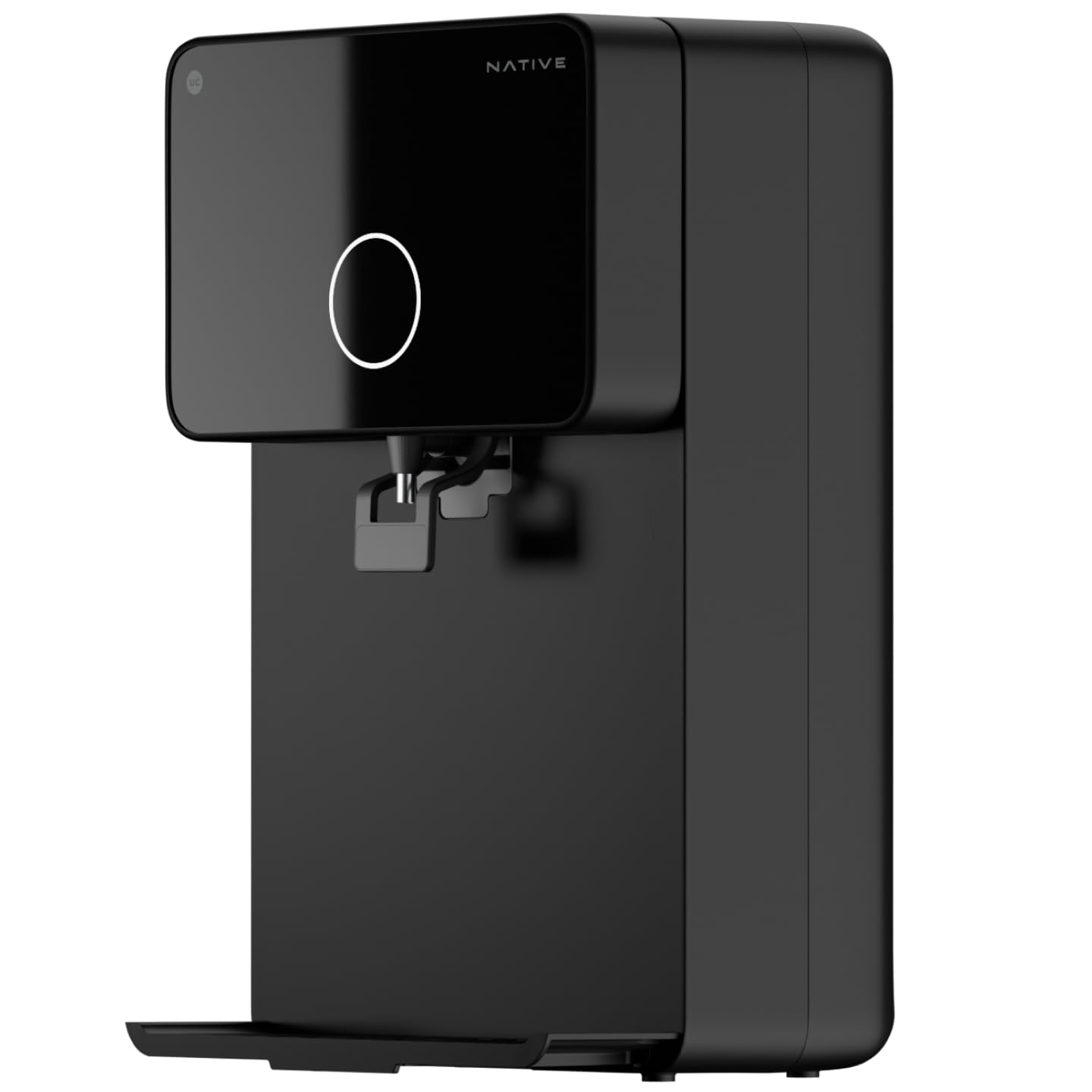
This is an RO and UV purifier with 10 stages, including copper and alkaline. It differs from the others in its 2 year no-service promise, and in sending all water through RO, with no TDS control. It is aimed at a buyer who wants fewer service visits.
Key details
- Type: 10 stages, RO+UV with copper and alkaline
- Tank: 8 litres, wall mounted
- Filter life: listed as 2 years, with no service needed
- Warranty: 2 years on filters, membranes and electrical parts, as listed
- Box: purifier, installation kit, external sediment filter, manual and warranty card
- The warranty is listed as covering filters whatever your water quality or use.
- Installation is listed as free.
- Fewer visits may suit a town where service is hard to get.
- After 2 years you pay for a filter refresh, so add that to your yearly sum.
- Flow, TDS limit and rejected water are not listed, so confirm them.
- Some homes may need pressure equipment at extra cost, as the listing says.
Good for: A busy home that wants to avoid regular service calls.
Wasted water and running cost
RO sends some water down the drain. Take an example of a family that uses 10 litres of drinking water a day, with a unit that rejects 2 litres for each litre it makes. That is 20 litres rejected daily, or 7,300 litres a year. A higher recovery figure means less waste, so compare it. You can collect the rejected water for mopping or flushing. It has more salts, so avoid using it on plants.
Electricity is a small cost. As an example, a 60 watt unit that runs 2 hours a day uses 3.6 units a month. At ₹8 per unit, that is about ₹29. Your rate depends on your state and how much you use, so check your bill.
Filter and service cost over a year
This is the cost many people forget. Use this list when you ask for a quote.
| Part | Ask this |
|---|---|
| Sediment and carbon filters | How often, and what is the cost of each? |
| RO membrane | How long does it last with my TDS? |
| UV lamp | How often, and who replaces it? |
| Yearly service plan | Which parts and visits does it include? |
Then add it up. The numbers here are made up, only to show the sum. A ₹15,000 purifier with ₹3,000 a year in service costs ₹30,000 over five years. Compare that total, not only the price on the day.
Before you buy
Check wall space, a nearby socket and a drain point. Ask who installs it. Confirm that an authorised service person covers your area, because small towns can wait a long time. Filters are not a choice you can skip, so plan for them from day one.
Read next
We read the Amazon listings, compared the details and noted what they leave out. We have not tested these products, and brands do not pay to be listed.
Common questions
What TDS level needs an RO purifier?
A common rule is to look at RO when TDS is above 500 mg/L, the acceptable limit in the Indian drinking water standard IS 10500. Below that, the choice depends on taste, your source and any lab result.
Does a TDS meter show if water is safe?
No. It shows only the amount of dissolved solids. It does not show germs or name the salts or metals present. That needs a lab test.
How much water does an RO purifier waste?
It depends on the model and your TDS. An older, ordinary RO unit can reject two or more litres for each litre of drinking water. Check the listing.
Does a water purifier work during a power cut?
RO and UV units need electricity to purify. Water already in the storage tank can still be used on many models.